Unknown's avatar

About Harold Rhenisch

www.haroldrhenisch.com

Nature Morte: A History of Apples in the Okanagan Valley

I have the good fortune of being a part of Christos Dikeakos’ new photography project documenting and deconstructing the death of fruit growing as an aesthetic and cultural response to land in British Columbia’s Okanagan Valley. Here’s a handsome photo of windfall apples on the cover of the book:

naturemorte

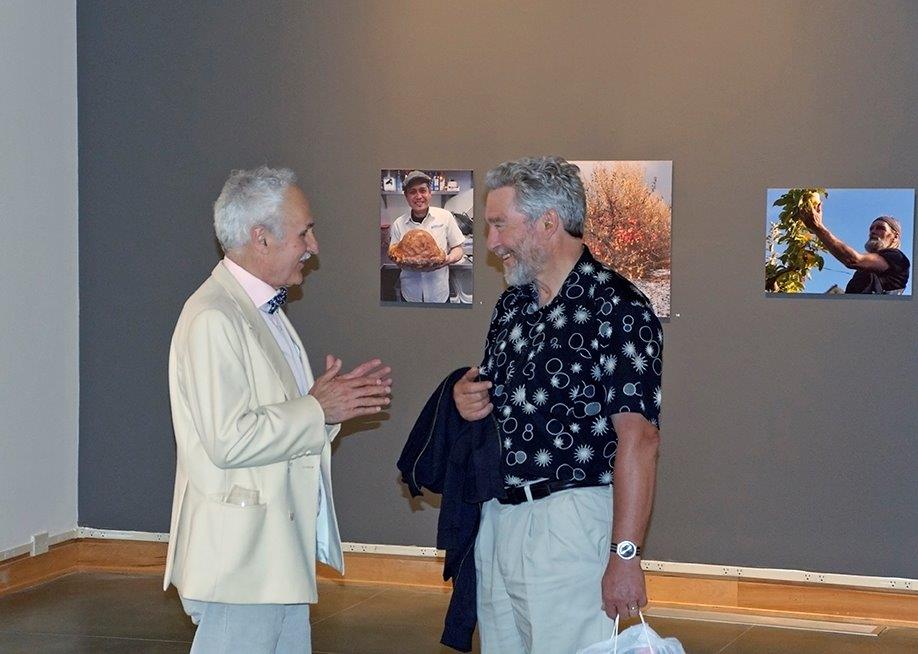
They look rather like Empires, one of the varieties I grafted a lot of back in the 1980s, as we tried to save this industry from the death wish caused by existence in a non-agricultural nation. My role in the book was to write the text, which I call “Okanagan Delicious”. Here are Christos and I meeting at the reception.

_DSC0517

Photo: Pauline Petit

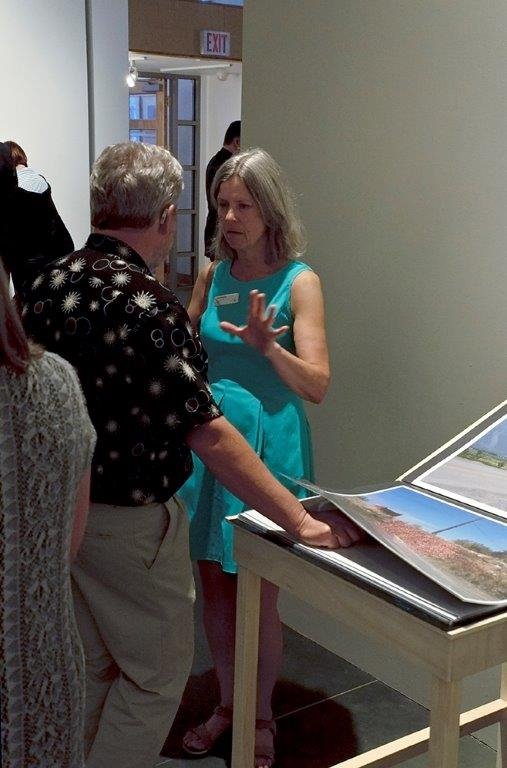
And here I am with Kelowna Art Gallery curator Lyz  Wylie. It looks like she’s trying to rein me in, but, really, it’s her tricksterish intelligence coming through.

_DSC0498

Photo: Pauline Petit

Here’s a tiny sample of the text:

The summers [in the Okanagan] are dry, yes, but what makes them so is not so much the sun but the seasonal weight of the air. The rain that drizzles out of heavy air in November or March, or which pours in day-long floods in June, or dumps down in five minutes of lightning-induced hail in the nearly weightless air of August, all adds up to about five centimetres a month. That’s not all the water there is, of course. Much more than that falls from the clouds, but it’s reabsorbed by the pressurized dry air long before it strikes the ground. The effect makes for sensational sunsets, with red, orange, yellow and deep purple light undulating in watery sheets against pastel blue mountains. It’s easy to watch it mesmerized for hours. The plants that thrive in these conditions of vanishing water are adapted to cold, heat and drought; they survive by water conservation, careful choice of location or season, speed of maturing, or special cell structures. The Turkish, Georgian, Armenian and Chinese fruits that were spread throughout Europe by the monastic cultures of the Middle Ages — grapes, apples, quinces, pears, cherries, peaches, apricots and plums — lack these adaptations. The vineyards of France, Switzerland and Germany, for example, aren’t planted in the heat; they grow in the fog. Apples thrive best in humid New York, England, Denmark and Germany, not here.


You can get a full introduction to the show at the Kelowna Art Gallery website, or by skipping across the street from that cultural district anchor, the Casino. Here’s a link. The beautiful, full-colour exhibition catalogue is available at the gallery, or at Art Books Canada. Here’s the link, where you can purchase your copy. This is a very beautiful work by a great  Canadian photographer, with texts by Jeff Wall, Claudia Beck, Liz Wylie and Harold Rhenisch.


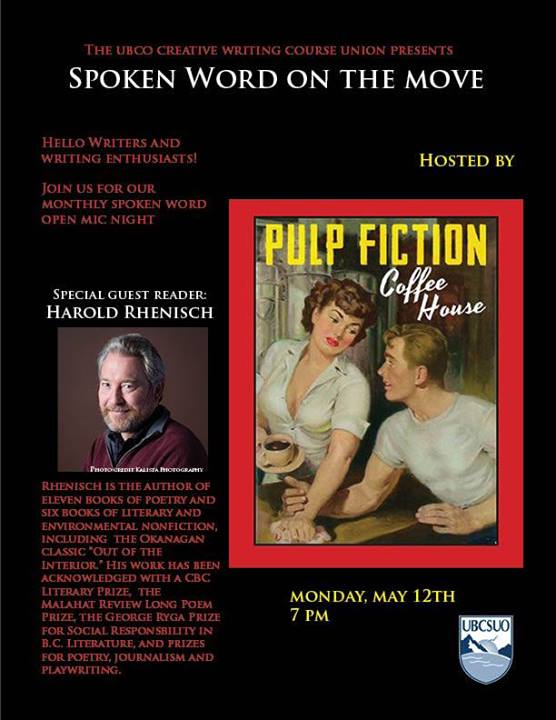
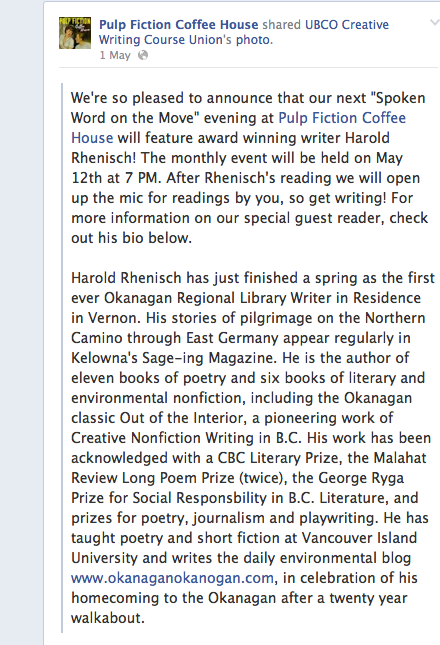
I am Reading at Pulp Fiction Coffee House on May 12

Pulp Fiction Coffee House, Kelowna 

What? Who? Where? Whaaa? Click here. All will be revealed. When? Aha …

7pm. Monday May 12.

What?

I read my stuff. The audience reads their stuff. Perfect. Especially if we talk. We will talk, right? Good, that’s settled.

10155082_698271330234504_8112413499684494890_n


Good gawd, bring your camera. Let’s get a better picture. After all, my Facebook picture looks like this:

383043_10151248054102551_1421982753_n


And that’s a funeral picture. In a dead man’s suit. Imagine what I look like in Real Live Kelowna. (By the way, I meant the green to reference the Green Man. You know the guy. Before Darwin, he held the fort.


Here he is putting in yeoman service for anyone leaving the private gallows of the civic chambers of the German city of Görlitz, on the Northern Camino.

greenmanTempted to show  up? I’ll read my poem about Fish Lake. The one with the hee hee na. Or, rather, I think I’ll get Coyote to read it for me. What are friends for, right?

pulpdog


I dunno about Pulp Fiction, but I’m working on a manuscript about the Okanagan that lets Coyote have his say.

Here’s Pulp Fiction’s teaser…

pulp1Gosh, you like being teased, right? I came back to the Okanagan for a reason. It has to do with putting an end to the American Civil War. Is that enough of a tease?


How about this, then? People like Pulp Fiction!  I like Open Mics. Do come.

pulp2


See you there!


Vernon Public Library Writer in Residence 2014

Looking north …P1070930

… or south …P1070992

…this is exciting!  The Vernon branch of the Okanagan Regional Library is bringing me in from February 14 to April 11, to put writing at the heart of downtown. We have 1970s era statues that are like books down there ….

P1080005 and poetic trees.

P1080010… and whatever else we make together. It will all kick off at 3 pm. on February 14, with a talk and a discussion about writing today, about where we’ve come, where we are, and where we might be going. It’s called Writing Community. See you there, across from the rowan tree of Ancient Wales.


What is Art For?

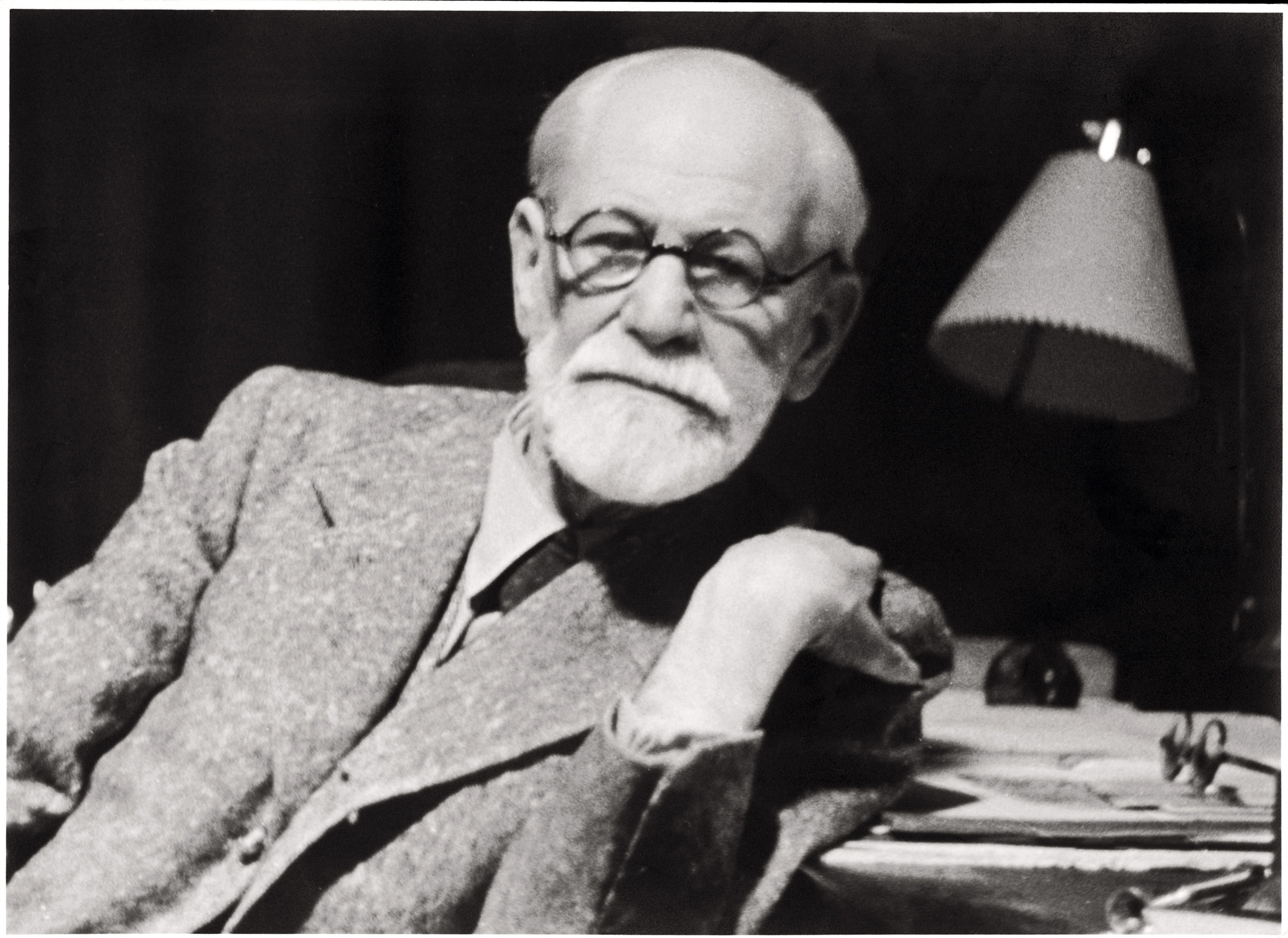
My friend Sigrun, who lives in a harbour in Norway and writes about art on the inspiring web log, Sub Rosa, has posed an intriguing question: Is Art Therapy? It’s not Sigrun’s question, actually, although she wrestles with it as openly as she does many challenging works. It comes from her reading of Alain de Botton & John Armstrong’s book Art as Therapy, which proposes that art, rather than having transcendent goals, metaphysical roots, or philosophical underpinnings, or even proto-scientific experimental methods, is a form of therapy. This proposition would mean, I think, that artists look like this:

Sigmund Freud

The Artist Formerly Known as Sigmund Freud Showing Off His Wrist Flexes

Some no doubt do. I am writing this today not to challenge Sigrun. Her open intelligence needs no challenge but only the respect that it gives to the world and all things in it. I’m writing this to challenge de Botton and Armstrong. I’m doing so, because according to their proposition, this is therapy…

vincent_van_gogh_-_branches_of_an_almond_tree_in_blossom_f671

Almond Blossoms, Vincent Van Gogh

It’s preposterous, really. Yes, Vincent was on an uneven keel, and this painting, despite the beauty of its colours and the intricacies of its forms, is a bit bonkers and smells of the kind of clarification out of anguish that early 21st Century culture recognizes best as therapy, but logically that doesn’t mean it’s therapy. For one thing, Vincent pursued his self-immolation or self-re-assembly, however you wish to put it, through a series of strategies that have come to be called art. Art, however, in the sense of artifice and the making of useful or decorative articles, came long before it was given a name as an aesthetic activity, the one that fills galleries and university Fine Arts departments. That aesthetic form of art is a creation of science, which needed something to separate itself from, and like science it is an abstraction built out of an earlier form of unified work. What was there before aesthetic art? Art was the means by which the aristocracy designed and ruled their estates, for one thing, and for another it was the capacity of humans to integrate a set of learned procedures into gestures of great subtlety and grace. Such gestures might include the art of fencing, or the art of arrow-fletching, or the art of good talk, the art of cooking, or even the art of creating symbolic objects with a language of their own, in social conversation with the aristocracy, but not of it. Objects like this:

David_-_The_Death_of_Socrates

The Death of Socrates, by Jacques-Louis David.

The sentence of death of the Greek philosopher Socrates and the courage with which he faced it (in this image, he is reaching for the cup of poison decreed by the Athenian court, as punishment for leading the young men of Athens away from marriage and into orgies of gay philosophy and kalamarika), is one of the central images of romantic humanism (well, short of the gay reference). The only thing is, the figures in the above image are wrong, and the old man sitting at the foot of the bed, Socrates’ pupil, the philosopher Plato, should be young in this image. Well, that is if it were an image of time and place. It isn’t. It is an elaborate social gesture. It was through such sleights of hand that the painters of the pre-industrial tradition maintained a conversation with each other, beneath the noses of their noble and bourgeois patrons. Is it therapy? Well, it’s an image that could be used in therapy, because it is almost endlessly narrative, but why is it so? Because of the arrangement of space and colour and line, at their junction with an arrangement of history and time. Is that therapy? Hardly. It is politics. It is an embodiment of Christian symbolism and ethics. It is artfulness. It is a gesture. It is all of these things at once. To suggest that this is therapy is to suggest that early 21st century understanding and concepts are the measure of all of human history, or that early 21st century deconstructionist art and art installation is the pinnacle of all of the human capacity for art in all of time. That’s just silly. Art is human. Humans are art. The whole world’s going to show up there. It’s a language.

P1320342

The Language of Art is Continually Reinventive

So is human-ness. They are the same. Art is a mirror.

Art is a mirror? Well, that’s not exactly the same as therapy, is it. Still, there can be art in therapy and therapy in art, and as the authors of this discussion point out, and Sigrun so generously lays out for us:

The authors see art as a tool, which has the power to extend our capacities beyond those the nature has originally endowed us with. While traditional tools often are extensions of the body, art is an extension of the mind. Art, says the authors, help us with psychological frailties.

Oh well, so much for poets and musicians and barrel wrights. We are only speaking about intellectual art here, the art of the mind. But that’s a bit sly. This tradition was invented for practical purposes, and holds within it that gesture of deliberateness. Every human who confronts it has to accept or reject or somehow come into conversation with that structure of power. What’s more, every gesture of paint on canvas has been made by the body as much as by the mind. They come together in the art. It is a language exquisitely not of the mind. To apply to all of art a definition of art rooted in Enlightenment ideas of the primacy of intellect, just because they share the same name (art), is plain silly, but so it is in a contemporary kind of rhetoric that substitutes partisan debate for discussion. Sigrun, in her generosity and endless curiosity goes on, to explain the authors’ thesis:

The seven functions of art are:

  1. Remembering
  2. Hope
  3. Sorrow
  4. Rebalancing
  5. Self-understanding
  6. Growth
  7. Appreciation

These are to be understood as therapies. Well, it’s the function of memory to remember, of hope to hope, of sorrow to grieve, and so it goes, on and on. These capacities come before therapy and remain a part of daily human life. They’re just words, that’s all. It’s a dangerous thing to do as these authors have done and to transfer the words back onto the world. That’s rather artless. Might it not be that rather than art being therapy, therapy and art both are drawn from life, and that there’s a bit of therapy in art and a lot of art in therapy? Might it also not be that if any particular approach to art tips over that threshold and becomes therapy, that it is indeed therapy, just as the author’s suggest, without changing the definition of forms of art that have not made than change? Of course, it might be. The real question presented to us here is whether there is a line that has evolved over time, of which only the leading point of that line can be called art; anything else is an echo of art. Well, if one wants to define art that way, sure, but this remains:

P1330192

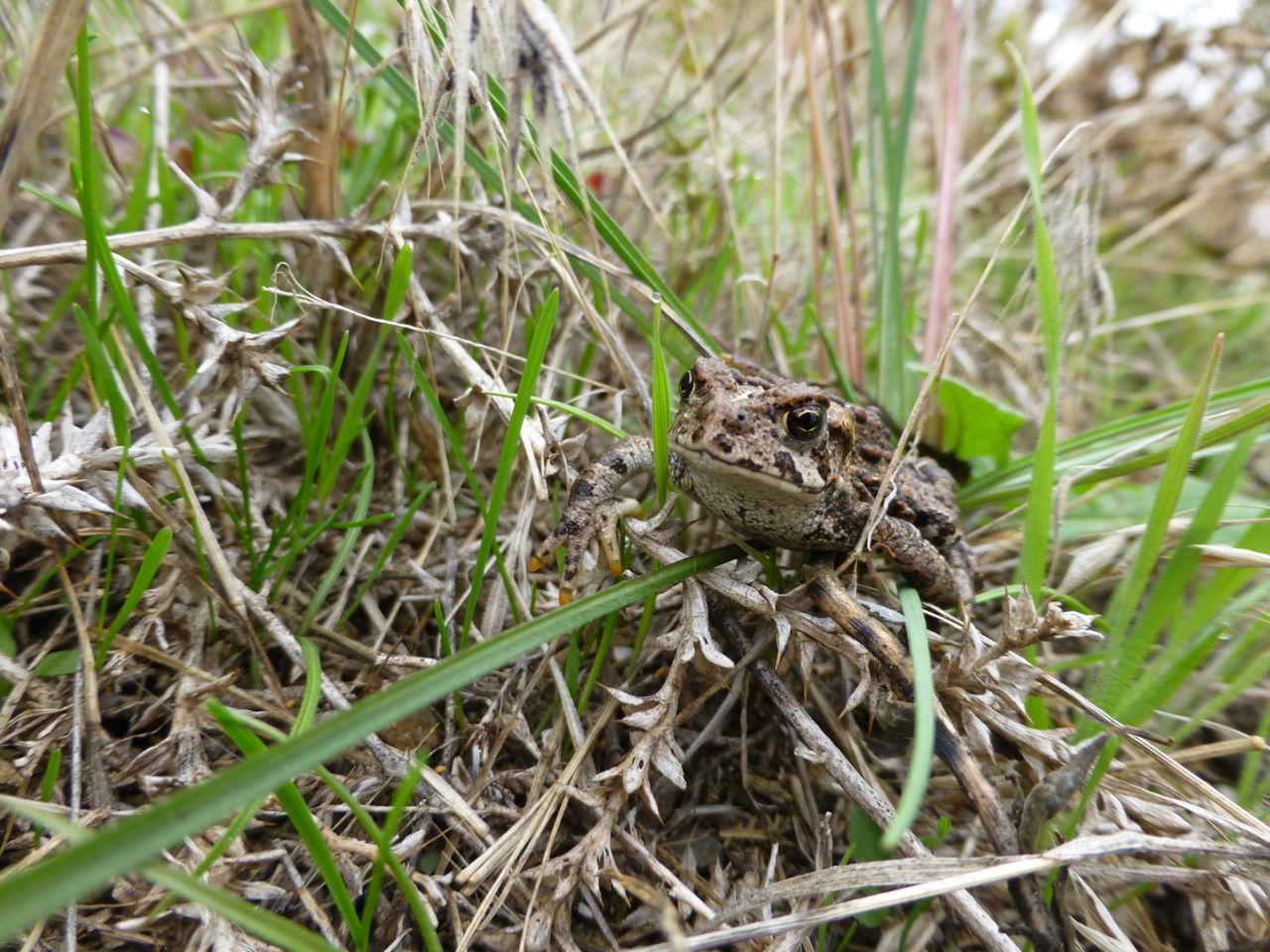
 Toad Wishing I Would Just Go Away

Humans may have evolved far past toads, but toads are still better toads than humans. It’s not a contest. It’s not a value judgement. What’s more, this image, although documentary in nature, is so because of the artfulness in it: the long tongue of green extending from the toad to the lower left, anchoring the image in the foreground, although the toad is off balance to the right, and so on. That’s not therapy. It’s how the human mind works. It lives in the same territory as therapy, and it can be used for therapy, just as therapy can be used for art, but it’s just not the same thing at all. There is no dichotomy here between popular sentiments set up to be knocked down like straw men. There are toads, and there are humans, and there are our particular ways of being, on this planet in which almost all life forms come together from two genders and create life from their coitus, their being together, their union. Art is like that. Like humans, it is very much of the earth and of bodily experience. Like words, it is a language. It can be used for many things, including therapy… or not.

Presenting the Haig-Brown Lecture

Tomorrow, I’m off to Campbell River on Vancouver Island, to present the 4th Annual Haig-Brown Memorial Lecture in Environmental Writing. I will be arguing that this Icelandic River lies at the heart of Canadian political and environmental traditions, and is a place to situate our government.

p1430251The New Canadian House of Parliament

 Talking with the earth and including it in our social group is not a new idea. It is at the root of English. In fact, it is at the root of being human. If we, the people, reclaim that language, the government will follow. It will take time, but over time, we will speak again. Some of us will even speak like this.

p1430114

Harold Thinking Out Loud in East Iceland, April

When I get back, I’ll tell you all about it.

Talking Green Water

On Tuesday, September 17, I will be presenting words and images in a discussion about green water and new agricultural opportunities in the Okanagan Valley. Green water is water that passes through plants, rather than flowing in streams and pooling in lakes. It’s story is quite surprising in the Okanagan and, I think, quite exciting. The images come from two years of daily explorations of the grasslands of the Okanagan, the Cariboo and Washington. The presentation will take place outdoors at the Allan Brooks Nature Centre in Vernon. Time 7:30 pm. We’ll move indoors if the weather makes that a really grand idea.

Allan Brooks Nature Centre

On Allan Brooks way, off of the Commonage Road to Predator Ridge. The best view in the valley.

See you there!

Talking About Talking About Art

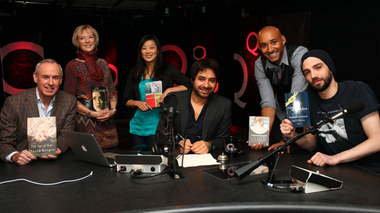
I believe that the writing of the future is here and it is largely present in the world of art writing. I say this in response to the many records of linguistic adventuring recorded in contemporary art writing. It seems to me that readers of art  have begun to apply their reading of images to a reading of language, without dropping the Height of the 19th Century language of popular culture. The result is a kind of century-wide gulf that art writers are filling with a cornucopia of undocumented approaches and techniques, while literary traditions are still largely back there before World War I. In one sense, this makes sense: the writers are supplying the background line, on which the art writers are scripting their texts. In another sense, though, it suggests that literary writing will soon be replaced by the new traditions being built up currently and almost out of sight. I think there’s a great opportunity in inserting some dialogue into this divided tradition. On the one side, literary craftspeople supply a pre-modern groundwork, vying to return 20th century literary experimentation to 19th century street ballad populism, such as this:
cr5-thumb-380xauto-293818

“Canada Reads” 19th Century Redux Populist Debunk-the-Book Event on CBC Radio Source

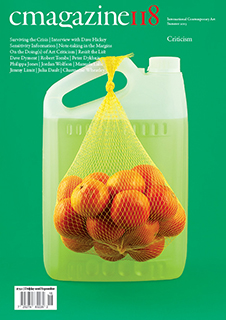
On the other side, artistic commentators riff off of them into texts that participate in the socializing and de-socializing effects of contemporary art practice. Since the future is being created in this maelstrom of divided roles, my suggestion is that some chat back and forth, in which everyone’s truths can be shared, will lead to a rich, literary future. If such dialogue does not take place, I foresee a future in which the knowledge of the literature of the last century, and all of its powerful engagements during the political throes of the end of the Age of the Book will be lost.  I have been reading these magazines for a few years, tracking this new literary genre. Today, an article in Toronto’s C Magazine struck my eye.

2013_118

Jimmy Limit, Green Liquid with Yellow Bag of Mandarins on Green (…) 2012  Source

Well, to tell the truth, Limit’s image is not the image here. The real image is the magazine, the bar code, the paper it’s printed on, and everything. It is a sculpture.

The words of Stephen Horne’s article, “On the Doing (s) of Art Criticism, are a sculpture, too. He begins with a ritual nod to the current art world practice of preferring processes over objects, and observes…

I’ve been trying to think about what art criticism is, what criticality is — or could be.

Observes is a good word for this kind of thing. It is not that he is thinking. In fact, thinking eludes him, but observation stands in its place. That revelation is worth the price of the magazine alone. It only gets better. Two pages in, we get:

If one admits that there is no “outside,” the terrain becomes more interesting and, paradoxically, less familiar.

Did you observe what is happening there? No thinking, and no meaning at all. In fact, thinking, argument and meaning are not the strategies here. Those are literary strategies. What is important here is observation, and a dance with ritual amulets. Doubt me? Take a look at what happens when the text is gently pushed with some basic literary interventions …

If two admit that there is no “outside,” the terrain becomes more interesting and, paradoxically, less familiar.

If three admit that there is no “outside,” the terrain becomes more interesting and, paradoxically, less familiar.

If four admit that there is no “outside,” the terrain becomes more interesting and, paradoxically, less familiar.

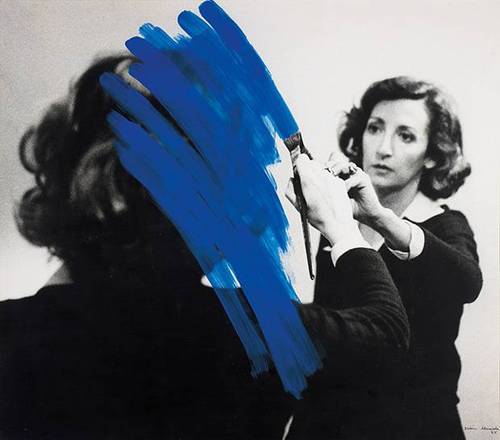
One could, of course, go on. With each of these tiny manipulations, the text reveals the preference given to singular identity, held at the illusion of an objective distance, although there is no distance in a literary object that has not observed its workings beyond the most superficial level. Distance, in other words, is not the goal here, but closeness. The words are being painted, for their emotional resonances and their ability to constrain thought, rather than the literary goals of extending and developing it as part of a tradition. But that probably sounds like gobbledy-gook. Here, visually this is kind of what I mean:
tumblr_mdtz0mFwTJ1rwkvi9o1_500

“Pintura Habitada” (Inhabited Painting) ~ Helena Almeida, 1975. Source.

This is more or less what Horne is doing with his words: by laying down quick brush strokes, he defines a reader’s approach to the white page. Almeida was doing it with the white backdrop to a photograph. You could do it with a white canvas, or with something like this (although no blue is involved) …

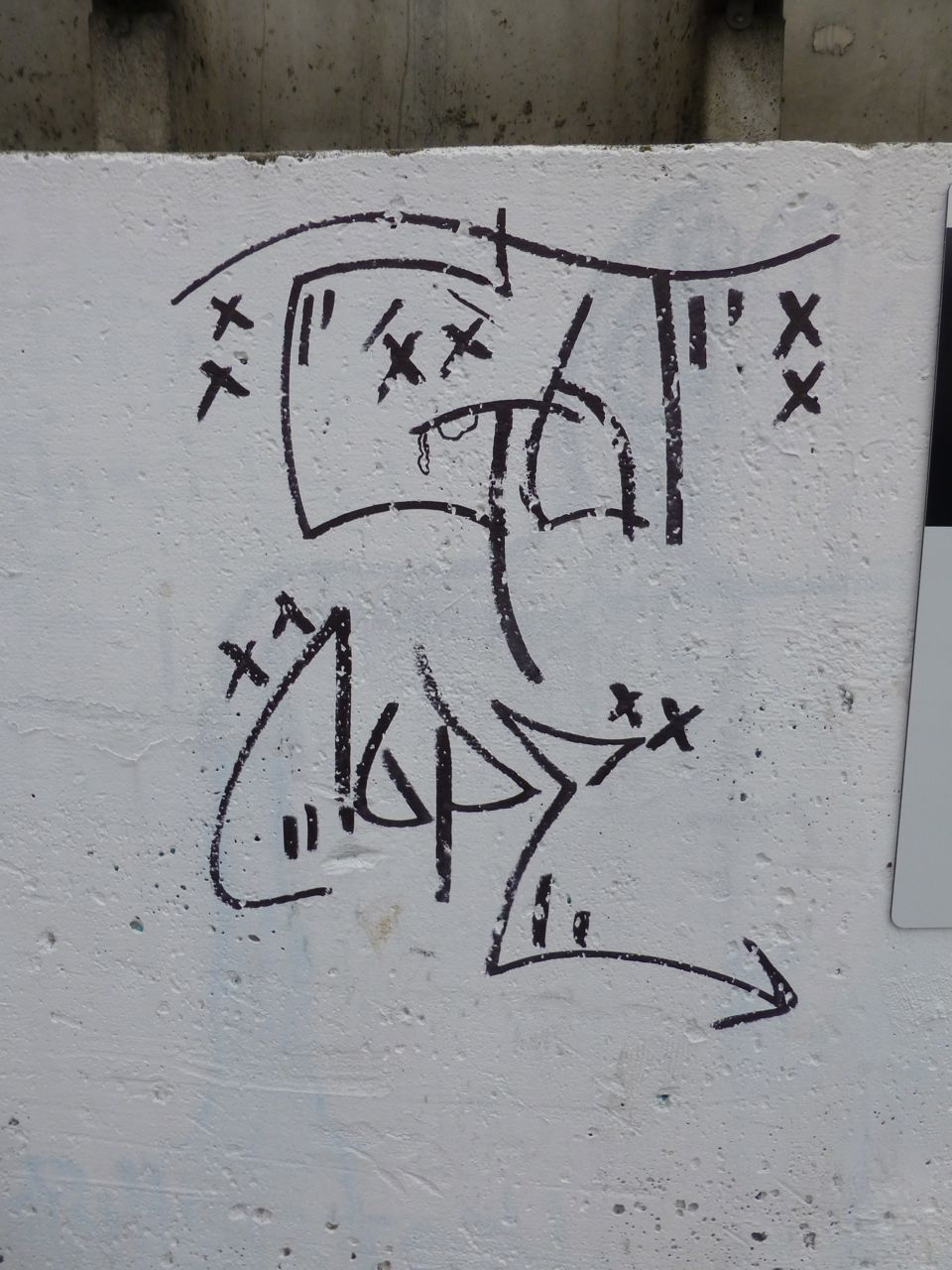
P1080795Signed Building, Kelowna, British Columbia

Take a look at the previous signings that have been painted over by the building’s owners. They are important here.

Just as the building’s owners in the above image have missed the purpose of this art, to claim the public image of the building which inhabits the private space of the person not wishing to be erased by its occupation of space (and thus using indelible pen to leave a trace of his or her own public image, a name), literary readers might easily miss that Horne’s article is not a piece of criticism at all, but a painting, using as a palette a series of resonances. The way in which literature can speak to that is, thus, not in the realm of argument, but in the realm of physical manipulations of the space of the painting (which uses the medium of text and is called “On the Doing(s) of Art Criticism by Stephen Horne.” Again, gobbled-gook. Here, the following should be clearer. First, Horne’s image:

Making suggests a certain way of regarding time: it builds an object, moves from a plan (concept) towards completion and end-product, with the result being a material object that already ‘gives’ a market relation.

All the important social gestures of the art world are there.  But look what happens with even an initial treatment of it as text rather than as paint:

Timing suggests a certain way of regarding making: it deconstructs an object and moves to a plan (concept) from completion and end-product, with the result being a market object that already ‘materializes’ a given relation.

Same syntax. Same words, but now the capitalist underpinnings of the approach are revealed more strongly, although very little else of the apparent meaning of the sentence is changed. Meaning is, in other words, a ghost. You can do anything with it that you want, and are not limited to Horne’s approach. Now, in literary writing, this is all a kind of red flag: if the syntax is allowing any meaning to be plugged into the various slots of a sentence, then the writing is just coasting. You could take this to an extreme and get this (which can be completed any way you like, and arrive at more or less the same end, which is predetermined by the syntax):

—— ——– – — — ——— ——: — ———— — —— — —– — – —- (——-) —– ———- — ———-, —- —- ——- – ——- —— —– ——- ‘————‘ – —– ——–.


Some forms of poetry do just that. The thing is, though, that this is a century-old observation. More interesting is that cover to C Magazine. Here it is again:

2013_118

An Art Object that Is Actually a Magazine Cover

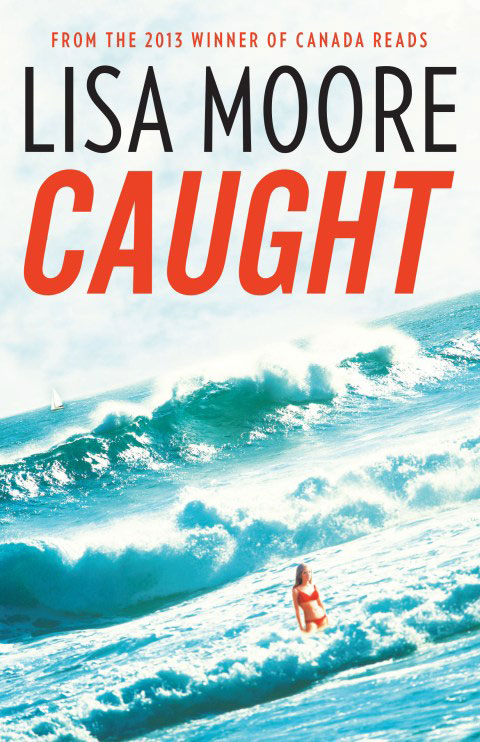
Compare to a book cover. Here’s Lisa Moore’s February, which “won” the Canada Reads verbal boxing match for pop culture literary championship this last February:
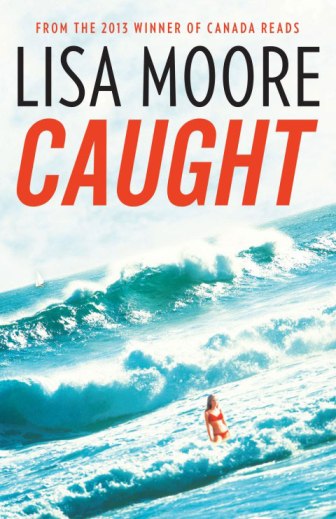
hot-ticket-Lisa-Moore-CaughtWords Are Used to Lead to Image

The process of reading entangles word and image. 

It’s all designed to catch, rather than enlighten, a reader (although that’s not Moore’s intention, of course, but this is a book, not a manuscript, and it has several faces). Now, here’s another by Lisa Moore:

February_Lisa-Moore

See how the text has been laid over the image in the same way as the USB code in Limit’s C Magazine Cover?

twoNow, one more manipulation should make this interesting indeed. I’ll add a text from the High Age of the Book, to show you how much has changed (and stayed the same)…

threeSee that? Both types of image represent their underlying syntax, or the technology that they were reproduced by. What’s more, we’re no longer in the age of text, but in an age in which text is image and image is text. Reading is now a visual experience, and the reading of Horne’s essay is also one. In fact, I suggest that his concept of “art criticism” is a form of painting. Rather than creating meaning, he is inhabiting the world that the poets of 1914 were working towards, as they tried to get beyond the limitations of argument. Well, it worked. It started with stuff like this:

The apparation of these faces in the crowd;

petals on a wet, black bough.

Ezra Pound

Now, that attempt to replace “meaning” by a sudden visual knot, looks like this, in the robotic, populist literary genre called Wikipedia, which represents an attempt to transfer the concept of meaning from the old textual world to the new visual one. Intriguingly, the use of robotic and electronic technology has a big effect, as the writer attempting to “define” Pound’s poem, winds up hectoring and saying banal and irrelevent things..
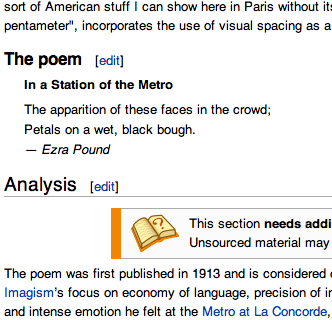
metroStill, the splicing work of turning it into a visual object, reveals more than the text did. In this new universe, it is Horne’s approach, and that of art criticism (remember, it is painting, not argument, in the sense of a painter laying down brushstrokes over brushstrokes over time to create an immediately perceivable illusion) in general, which is the most honest. Horne makes a comment which speaks well to this point. Here it is:

If ‘waiting’ is conventionally understood to be passive while ‘doing’ is active, the space that is art disrupts the binary in favour of a space that is in play.

Applying a literary manipulation (an active reading, in the sense of the Creative Writing school that Robin Skelton tried to start in Victoria in 1967, in which creative response was the communication, not intellectual analysis … a bit before his time, he was) to that text-image, we get:

If ‘writing’ is conventionally understood to be passive while ‘painting’ is active, the space that is art criticism disrupts the binary in favour of a space that is in play.

And that’s pretty much what Horne is doing. One can go further:

If ‘writing’ is passively understood to be conventional while ‘painting’ is active, the space that is art criticism disrupts play in favour of a binary that is in space.

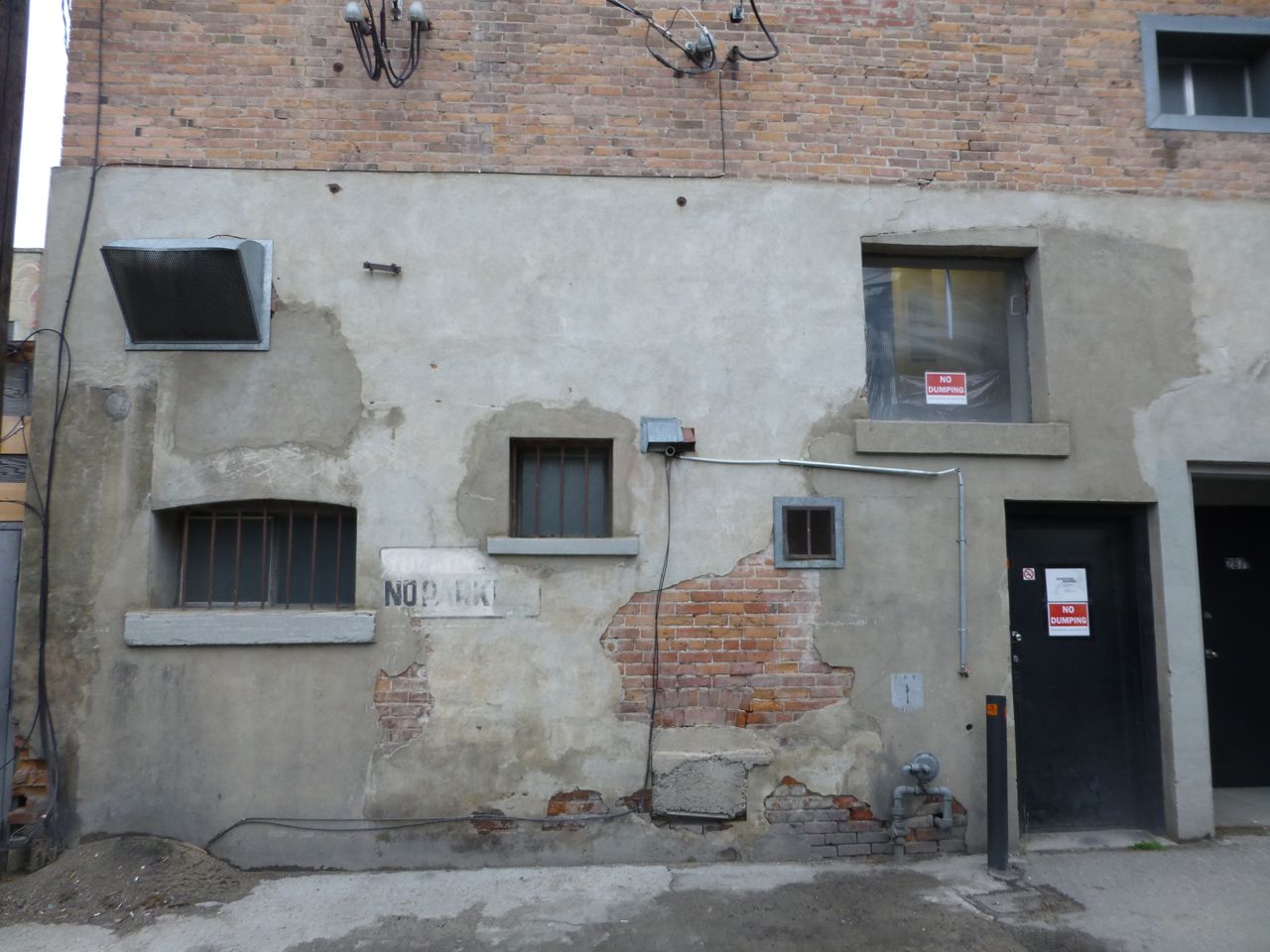
It means the same thing. In other words, meaning is not the issue. Criticism like this could be presented in a gallery setting, as a kind of variation on a theme, so popular back in the days in which painting and art were mostly synonymous, before art moved into reading. It could, however, also be presented in a book, and what is a book but a gallery space, or a theatrical space unfolding in time. And what’s that, but a sculpture? Here’s one:

P1080762Alley, Kelowna, British Columbia
Note the painted-over graffiti on the right. No, you an’t see it, but the grey paint reveals that somewhere, deep down, it is there. Keep that grey paint in mind as you read on.

Do you see? This photograph is a sculpture of time and space. It has been selected by the eye (mine), which has recognized a conjunction forces, in the syntax laid down by a machine meant to mimic the human eye: a camera. A camera is a creator of human spaces. The human who operates that machine is sculpting them, out of a flow. As long as it flows, it’s not time or space, not in the new visual understanding that Horne lives so well within. Now, there’s a lot more to be said about this intriguing photographic space, but I think one more image will do for this introduction to the future.
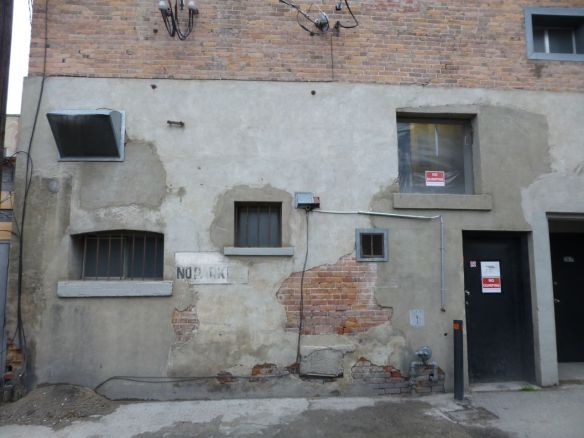
P1080763Alley, Kelowna, British Columbia

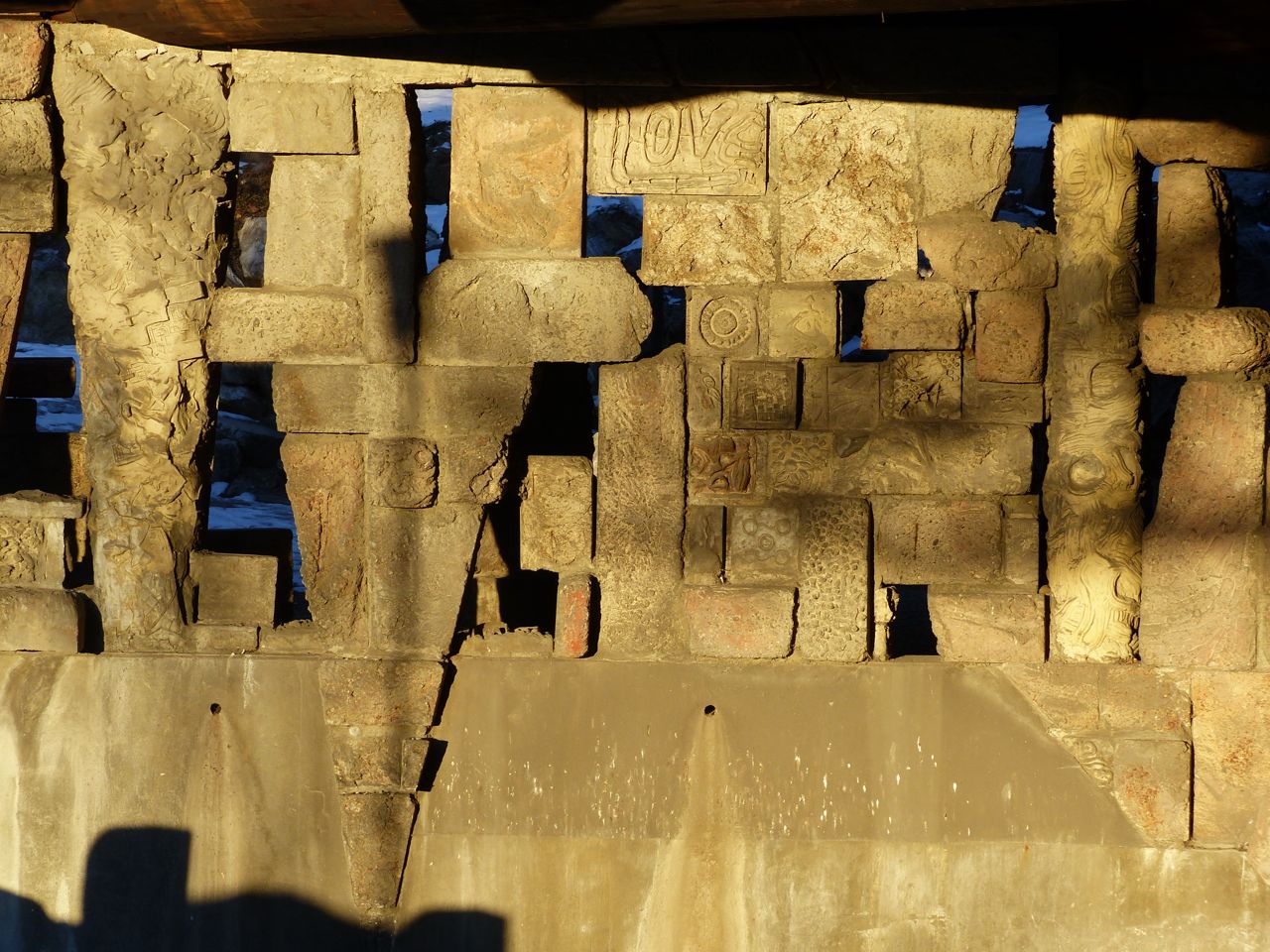
The many layers of concrete, plaster, signage, brick, windows, and so on, on this wall are no different than the work of a sculpture or of a painter on canvas, or of Horne, who uses words in their place. Even the building owner who tried to assert ownership over the public image of his back wall by painting it with grey paint, was living within this visual universe. Only the art critical writers, like Horne, have found the language that speaks to this new world, of a new century. That’s where the literary spark has gone now. Fortunately, for those skilled in words, in a textual sense, there is much that literature can add to this new genre. There is much good work that we can do together. I, for one, am working on it by creating books that work as photographic-textual sculptures that unfold in space and time.  They’re not written; they’re sculpted, as are blogs, such as this.
A Pilgrimage Through East Germany

The poet Daniela Elza has generously invited me to continue a conversation about books, called “The Next Big Thing.” Her opener is here. This is the Fourth of six projects in response, and the one I’ve been working on the longest.

 What is the working title of your next book?

White Noise

kaiserslautern


Barbarossa Monument, Kaiserslautern

Out front of just one of the Holy Roman Emperors camelots that were on the pilgrimage path.

Where did the idea come from for the book?

I was in Germany in 2003 and visited the former East Germany for the same time. A young man walked past me on the street, with a lot of body piercings, the German imperial eagle tattooed on his chest, with flaming pink hair and army boots. I wanted to know what he was doing in the town in which Luther translated the Bible.

 What genre does your book fall under?

Non-fiction, literary nonfiction, innovative fiction, drama, script for the book, history.

P1140877_2


Be Brave! Don’t Look the Other Way!

Anti-nazi street art, Jena, Germany

What actors would you choose to play the part of your characters in a movie rendition?

This IS the movie rendition, just screened within the pages of a book.

What is the one-sentence synopsis of your book?

Deep in East Germany, the third section of the play Faust takes place during the demonstrations that led to the reunification of Germany in 1990 and the growing neo-Nazi movement of the present.

anarchie


Anarchist Street Art, Jena

No God, No State, No Partriarchy!

Will your book be self-published or represented by an agency?

Unknown.

How long did it take you to write the first draft of the manuscript?

4 years and counting. I am rewriting the manuscript as a pilgrimage, on the ancient pilgrimage path, to see whether it’s really two manuscripts, with different purposes.

What other books would you compare this story to within your genre?

Faust, parts 1 and II, by Goethe;  Danube, by Claudio Magris.

twodicther


Harold and Goethe, Ilmenau

The poor guy looked like he needed some cheering up.

Who or what inspired you to write this book?

It struck me that much of German history happened along one ancient road, now called the B4, but previously called the via regia, or the King’s Way, which is the northern part of the Camino that is so well known in Santiago de Compostela, in Spain. I wanted to know why Germany happened along this main road to Minsk, and so I went to find out. It changed my life. Nothing was ever the same again. When I lost my photographs due to a computer failure, I went back, and did the route in the reverse, not from France to Poland but from Poland to France. Outside of Dresden in 2003, I had visited the town of Pirna — a visit interrupted by the unexplained panic of my guide, who bolted. I went back to finish the exploration…and discovered why he had bolted.

What else about the book might pique the reader’s interest?

It’s funny, and full of beautiful and surprising things.

radebeul

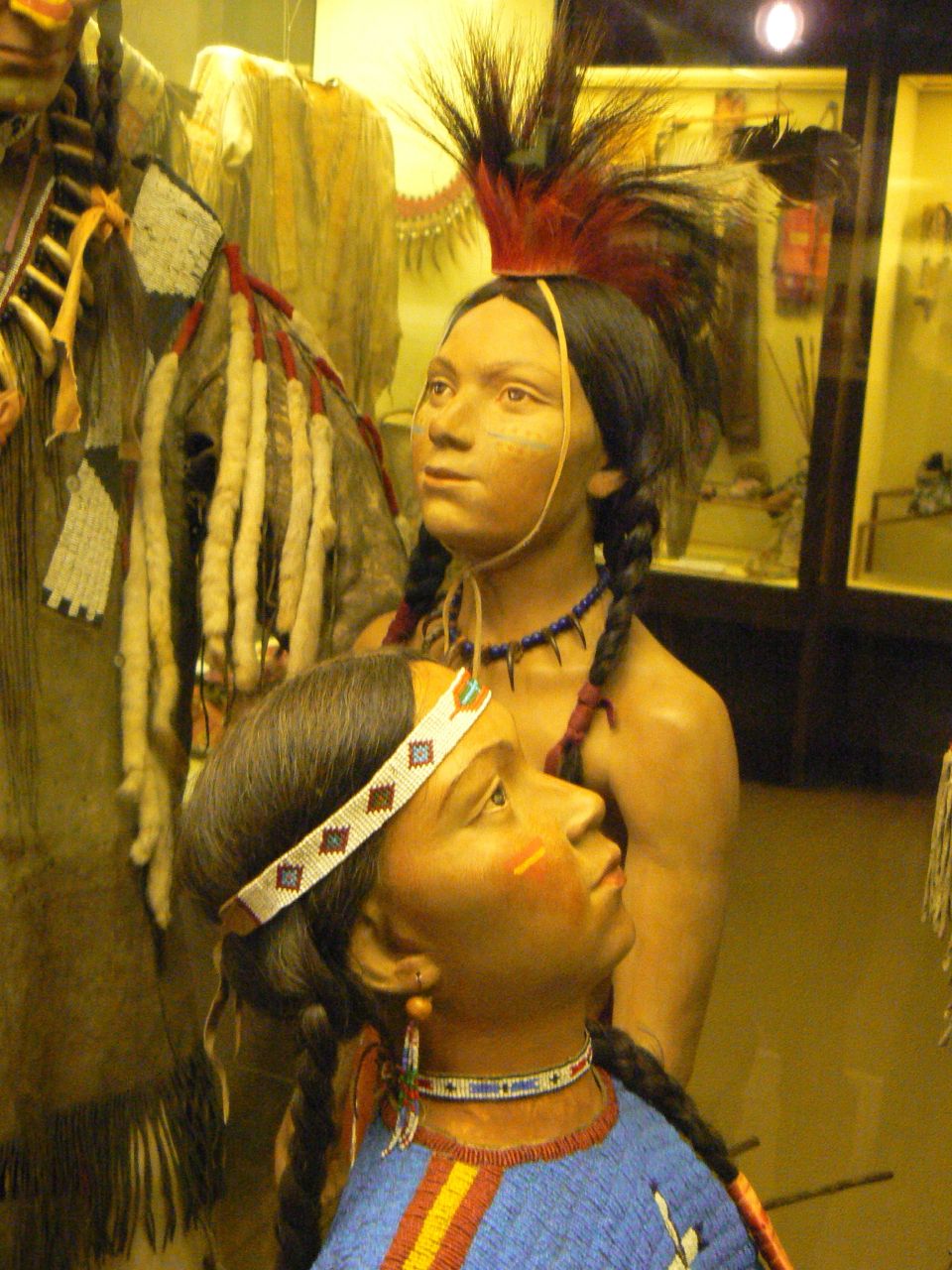
Two East German North American Indian Children (Whew!)

From the Karl May Indian Museum in Radebeul. During the East German period, half a million Germans dressed up like this and took to the woods every summer. It was one of the few ways of escaping the totalitarian state.
Next, a book about Iceland.


Reading Humans

The poet Daniela Elza has generously invited me to continue a conversation about books, called “The Next Big Thing.” Her opener is here. This is the third of six projects in response, each written by a different writer, within the community who go by the name of Harold Rhenisch. Harold, the author of 25 books, did not return from East Germany. He was burnt away. This is the new world now. It’s a fun place with, I think, a bright future.

 What is the working title of your next book?

Reading Humans

 Where did the idea come from for the book?

Plato’s Dialogues, in the largest sense. Imagine, being denied membership in the playwriters’ union and going off to invent a whole new form of writing and argument instead. That’s inspiring. Also the conversations with the dead in Hans Magnus Enzensberger’s Hammerstein.

Enzensberger_-_Hammerstein_oder_Der_Eigensinn

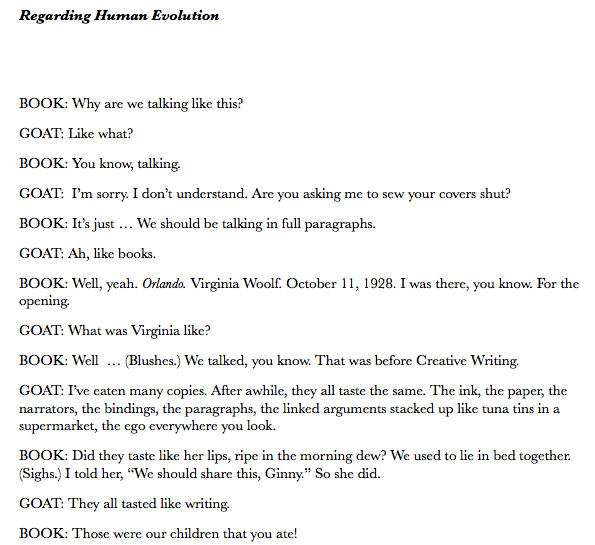
Imagine, using fictional conversations with the dead to create precision within a book of history, and entertaining readers (and oneself) at the same time! I found the technique compelling. That’s the form: conversations between a book and it’s editor and critic, a goat, who eats books. Along the way, these two tricksters play with and devour many thorny issues of contemporary philosophy and book culture at the end of the Age of the Book, including the Philosophy of Vagueness, the Philosophy of Information, Margaret Atwood, Creative Writing Workshops, e-Readers, Walter Benjamin, Starbucks, and so much more. It closes with the end of the universe. I was exploring the idea of using a book as a stage, on which scripts for humans were presented, which played out within the screens of the turning pages of the book.

 What genre does your book fall under?

Trickster tales, philosophical dialogues, fiction, play, creative writing manuals.

What actors would you choose to play the part of your characters in a movie rendition?

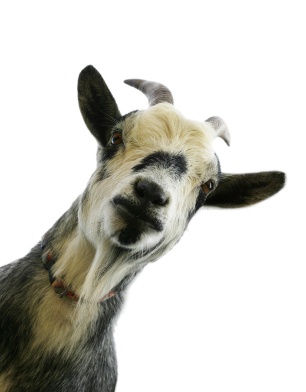
Klaus Maria Brandauer, Emma Thompson, Virginia Woolf, and this guy…

goat

What is the one-sentence synopsis of your book?

A book (a prey species) and its critic (a goat, who eats books) discuss the future of books from a bookstore near you to a little hideaway in the basement of the Restaurant at the End of the Universe.

Will your book be self-published or represented by an agency?

Time will tell.

How long did it take you to write the first draft of the manuscript?

One year.

What other books would you compare this story to within your genre?

Hammerstein, by Hans Magnus Enzensberger; Flirt, by Lorna Jackson.

flirt_2

Who or what inspired you to write this book?

I was working on the Human Nation project with Richard Rathwell and attempting to describe what a book would look like once it was written for the new electronic world, rather than just being transposed over into it.

What else about the book might pique the reader’s interest?

sample


Tomorrow, a Pilgrimage on the Camino.

The Art of Being Human

The poet Daniela Elza has generously invited me to continue a conversation about books, called “The Next Big Thing.” Her opener is here. This is the second of six projects in response, each written by a different writer, within the community who go by the name of Harold Rhenisch. Harold, the author of 25 books, did not return from East Germany. He was burnt away. This is the new world now. I think this project was written by a man called Harald Johannesson. The irony, that the Age of the Book is over, is not lost on Harald.

What is the working title of your next book?

The project comes in two parts. The first is The Art of Haying. It’s a series of meditations about the world past the Age of the Book. I’m serious. It’s time to make the future now. It is illustrated. The second is An Expedition to Iceland. It’s about Old Norse and English. Here’s a short sample from The Art of Haying…

~

….You may, if you want, listen. You may, if you wish, hear yourself think.

rain2

The Rain is Falling!

In the first instance of the rain before a downpour, the stones rise up. They stay there.

 You may, if you go out into the dark, hear the crackle of the Aurora over Husavik when the sun has gone down behind the hill. You may, on the other hand, if you go into your libraries, rediscover the world of books, and accept their invitation to dinner. If you choose that route, go without fear. You will feel no pain; that you have made that choice indicates that you already left your body long, long ago. Somewhere, wherever it is, it has made a life for itself without you: you who are a character in a book it wrote and set free.

south

Home

In South Iceland, sheep have view property. Humans, acclimatized to the mountains, stay where they belong.

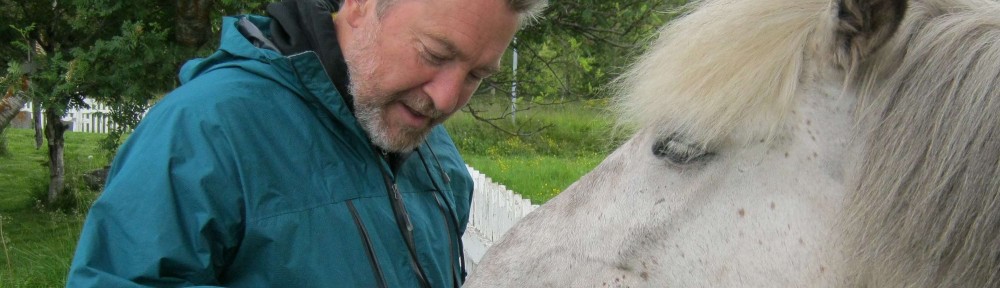
 Harold is going back to the horses. He left something there, something he would love to spend his life finding, and talking to.

troll

Five Horses

 find their troll.

~

An Expedition to Iceland came after a second trip to Iceland and an attempt to unravel the ancient technologies of string and line and the Norse roots of English. As its premise, it starts from the realization that the physical words of English are Old Norse and Anglo Saxon, and contain corresponding forms of earth knowledge. I wanted to explore what a book of poems would look like that went deep into this strata of the language.

 Where did the idea come from for the book?

I was working with Richard Rathwell on a project called Human Nation, which was a translation of his book of poems into a post-book format. In writing an introduction to it, I was exploring the territory it proposed: that there is a thing called social poetry, made out of texts and social networks, and a thing called human poetry, made out of human experience from outside of the world of the book. It was combined with a trip to Iceland to produce The Art of Haying. The string sequence from that manuscript …

~

This is Iceland. Here there is a technology appropriate to people who work with their hands and with the things of this earth: from stone a line, from a line an arrow, from wool a thread, from thread a yarn, from yarn a net, from a net a fence, a sweater, a snare, a hair, a brush, a line on stone, from all a flow, from flow a weaving, a this, a that, in air, with fire, on hide, of water, a current, on paper a river, a stream, a fall, a braid, a pool, a lake, a sea, and on the sea a shore.

planet A New Planet on the Shore

 3:30 p.m. July 20, 2010.  A new planet washes up on the shore on the edge of the black basalt cave just west of Vik, Iceland. The child appears to be doing well.

 ~

led to the second, in which paths, the lines men follow, are laid by sheep … and other creatures…

scree

 What genre does your book fall under?

Dicht, a German term for a kind of poetry that is the spirit of the world. It is a concentration, in the manner of wine-making, or the concentration of rain into a river. The German term for poetry, Dichtung, and for a poem, Gedicht, come from this root. In English, the word poetry holds these meanings, but without the linguistic clarity.

What actors would you choose to play the part of your characters in a movie rendition?

Eivor (do click on her name, the song makes living on the world come alive, and note her powerful exit), Arnar Jónsson

What is the one-sentence synopsis of your book?

The cultural and linguistic roots of English are found outside of the book, in a relationship with a physical world including trolls, elves, and ancient, magical technologies such as scythes and strings.

Will your book be self-published or represented by an agency?

Time will tell. Electronic, perhaps.

How long did it take you to write the first draft of the manuscript?

Two weeks, one week each. The prep took much longer.

What other books would you compare this story to within your genre?

Malcolm Mooney’s Land, by W.S. Graham. Any of the later novels (aka meditations on subjectivity) of Peter Handke.

Who or what inspired you to write this book?

Thirty five years ago, the poet Robin Skelton mentioned one afternoon that the roots of English were in Anglo Saxon. That was in the late 1970s, and he was working at the time on a series of books (Limits, Openings, Distances) which explored this idea. I edited his posthumous works in the late 1990s, and then a Selected Poems (In This Poem I Am). The result of that was my book, a posthumous conversation with Robin, The Spoken World. The result of that was this project.

What else about the book might pique the reader’s interest?

troll2An Icelandic Parliamentarian

 Staring out of the walls of the Mid-Atlantic Rift at Þingvellir, Iceland, a troll waits for parliament to reconvene. From 930 to 1789, the Icelandic parliament met under the witness of this troll and his companions. Officially, the site was chosen from a short list of four locations, as it lay at an intersection of the walking trails that crossed the island, and had a ready supply of firewood and water. It was likely on the list at all because of the trolls.

 ~

Tomorrow: the next project … The Book and The Goat: platonic dialogues between a book and its critic. A trickster romp. Again, Thank you, Daniela, and, again, my apologies for so thoroughly bending the challenge, but it was like that on my pilgrimage in the East.